The Buggy Crash
“Oh, he’s dead”
The red brake lights lit up the windshield in streaks, the way they do in late autumn when the air has just begun to get a proper bite to it. The car ahead of us lit their hazard flashers and pulled over. I braked, stabbed at the button for the hazard flashers, and pulled off the main highway onto a side road.
My wife and I had just dropped off our one year old at my parent’s house for a rare night out. We were both dressed in our finest for this treat: going out to eat at a beautiful vineyard bistro with our friends from supper club. We had dropped the baby off early, and were nearly an hour ahead of our scheduled reservation, giving us a little time to spend on just the two of us. Perhaps we would have time to enjoy a cup of coffee or a glass of wine before we joined our friends for dinner.
As I turned, my headlights illuminated a wreckage in the other lane.
The remains of an Amish buggy - nothing more than a pile of matchsticks - was in the roadway and the occupant’s personal effects were strewn across both lanes. A plain jacket, a lunch pail, and a backpack were scattered among the splinters of wood that had been a part of a buggy just a minute ago.
I parked and went to investigate further, my dress shoes clicking smartly on the cold pavement. My wife bravely hopped out of the car and followed me as I walked into the accident scene. If you can picture Audrey Hepburn gingerly stepping through the aftermath of an Amish buggy accident, you can imagine what my wife looked like as she picked her way through the wreckage.
We walked by a panicked man pacing wildly and screaming into his phone: “YES! I just hit an Amish buggy!”
My first instinct was to find the Amish people and the horse, neither of which were apparent at first glance. Other than the shouts of the driver, the scene was oddly quiet and calm.
It had just happened.
It’s not uncommon for the horse to run away from an accident scene, so I wasn’t surprised by the lack of a horse, but I thought it odd that I didn’t see any Amish.
I walked closer to the pile of splintered buggy parts that were in the road, and noticed an oil lantern hanging dimly off of the wreckage. The driver of the buggy belonged to the Swartzentruber Amish, one of the most conservative sects of the Old Order Amish. They shun battery LED lights and reflective triangles on their buggies, which makes them harder to see after dark.
As I walked up to the buggy I was shocked to see the crumpled body of an Amish man lying face down among the wreckage. His legs were sprawled awkwardly on the floorboard of the buggy, and his upper body was angled downward out of the buggy with his face resting squarely on the cold pavement.
My first thought was, “oh, he’s dead”.
Sign up to have blog posts delivered to your inbox:
In our mother tongue (PA Dutch)
I knelt down beside the man on the ground and put my head down near his ear and asked him in our mother tongue (PA Dutch) “kansht du mich headah?” (“Can you hear me?”)
I was relieved and surprised to hear a strong (if slightly muffled) reply “yah, ich kann” (“Yes, I can”).
His voice was surprisingly strong, but he lay still as death in that awkward position face down on the cold pavement. I knew I dare not move him, but I stayed crouched down close to his head and kept talking.
Again in PA Dutch I asked “vas shape bisht du drin?” (“what shape are you in?” … essentially asking for his own assessment of his condition).
He replied “I can’t feel anything and I can’t move anything. I don’t really have any pain”.
Spinal cord injury.
He had been struck from behind at high speed, with his lumbar region approximately at the height of a car’s hood.
“Your body may be in shock right now. Help is on the way.” I assured him in our mother tongue.
I rested my hand very softly on the top of his head and told him I can’t move him until help arrives, but that I would stay with him until the EMT’s get there.
My wife stood behind me, periodically prompting me about questions to ask and things to talk about as we waited for EMS.
I asked him for his name, (Enos) and his age. He was 21.
Same age as our oldest son.
I thought “what would I want someone to do for my son if he was in this situation”?
I knew that I would want to know if my son was lying on the road in so perilous a condition. I also knew that his parents didn’t have access to a phone. The Old Order Amish have mostly adopted cell phones, but not the Swartzys. They’re old school like that.
I told Enos that as soon as help arrives, we were going to go and notify his family. I asked where I could find a family member. With his face down on the pavement, he told me where to go to find his brother on Lawndell Road, just a few miles away. I promised him we would go and let his family know.
When EMS arrived and began cutting the buggy apart to rescue Enos, my wife and I hopped into our SUV and lit off for Lawndell Road to find a family member.
In the dark we came up on another Swartzentruber buggy stopped in the road, so we stopped again. The bright eyed Amish man named Sammy was holding the halter of the injured horse that had escaped the accident scene. I quickly told Sammy about the accident and the victim and confirmed that we were headed the right direction to find Enos’ family. My wife in all of her finery spoke soothingly with Sammy’s young children in their mother tongue as Sammy jotted down my phone number before we sped off into the night.
We pulled up to the farm that Enos had described. It turns out it was Enos’ older brother’s in-laws. Their daughter was married to Enos’ older brother Jacob, and the young couple had just moved into their new home on ten acres on the back side of this farm. Enos had been there for the day helping Jacob and his bride move into their new home, and had just left there a few minutes before he was struck on the road.
“The wise man who can lead his family fearlessly into the future will be the one who knows God and knows himself to such a degree that it allows him to enter into a shared human experience with someone very different than him, without fearing that he will lose something essential about himself in the process. ”
Stepping into the 18th century
Knocking on that front door was like knocking on a door to the 18th century.
No electric lights, no LED’s, no electricity, no running water. The interior of the home glowed with a warmth and simplicity that you just don’t see in modern homes.
It took the housewife a minute to make sense of this fancy looking couple on her porch who was speaking fluent PA Dutch to her and telling her that Enos had been in an accident.
She leapt into action, running off of the porch to go catch Enos’s sisters who were just getting into their own buggy to head home.
An Amish family materialized out of the darkness - an older man whose face was dimly lit from the glow of his burning cigarillo, the smoke wafting crisply into the cold night air. His calm presence was an anchor in the emerging chaos, and we all gathered into a tight circle to figure out what to do next.
Suddenly the air erupted with a cacophony of sounds - the passing emergency responders, Enos’s sisters crying out in anguish, my phone ringing with news from Sammy, the Amish man who had the horse, who was now at the accident scene.
One of Enos’s sisters kept repeating "I knew it! I just knew it! When I heard those sirens go, I just knew that Enos was in a crash!”
I answered my phone and Sammy told me: “they’re life-flighting Enos. He wants to see his family. The landing zone is at Wilmot school.”
I relayed this information to the sisters. I told them “We’ll take you to the landing zone. Who else needs to go?”
Brother Jacob, across the field, who had just moved into his new home that day. He needs to go.
They piled into our SUV and we went bombing across the muddy field to go get Jacob. The Swartzentrubers discourage well groomed driveways, so we followed the muddy tracks in the field to the newly built home.
We skidded up to Jacob’s house and his sisters ran into the house and told him about Enos. Jacob and his wife grabbed a few things and hopped into the back seat. One of the sisters went into the house and secured a “sick bucket” before getting back into our car. She knew that she was prone to motion sickness, especially so if her nerves were worked up like this.
With our car loaded front to back with Swartzentruber Amish, we went flying across the countryside, determined to get to the landing zone before the chopper left with Enos. We pulled into the school parking lot as the chopper was circling the ball diamond. As they spilled out of our car and went running towards the waiting ambulance, the helicopter settled onto field.
I have always been aware that I live between two worlds, and I felt this collision of worlds as I watched our new Amish friends run towards the ambulance with the helicopter landing just beyond them.
I share this video with respect - I know the Amish are not fond of having their pictures taken. I feel this short clip communicates something of the “collision of worlds” that I am trying to describe here.
Life in the — dash
The church I was raised in was a “Beachy” Amish-Mennonite church. Not quite Amish. Not quite Mennonite. We were the hyphenated blend of the two. That dash between Amish-Mennonite seems to represent where I have spent much of my life.
Between two worlds - fluent in two languages. Understanding and admiring the old ways while having a fascination and desire to experience the new things as well.
My very first online username in the 1990’s was “urbanamish”. The contrast between “urban” and “amish” was an expression of this hyphenation in my soul, and I truly felt like “urbanamish” on this fateful evening.
A PA dutch speaking neighbor who observed us with the Amish family pulled my wife aside and looked quizzically at her. “So… you speak PA dutch?” He struggled to understand. She affirmed that she does, and he smiled, shook his head and remarked “my, du gucsht aver ganz hof” (indicating colloquially that she looked like an “English” lady, not a “PA Dutch” speaking lady).
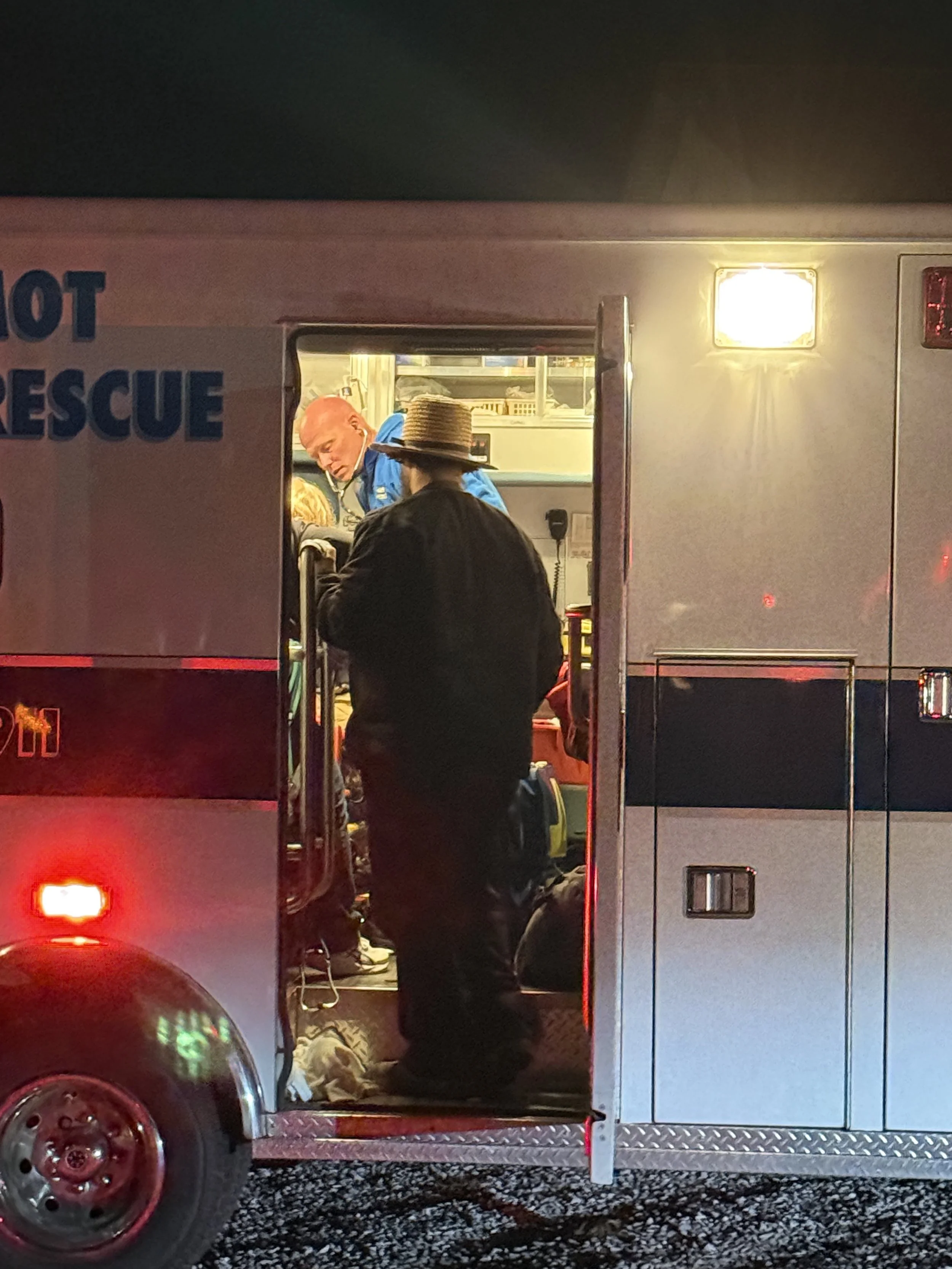
We gathered in a tight circle with the family and the EMT, who was keeping them from seeing Enos. One of Enos’s sisters plead earnestly with the EMT.
She looked the EMT in the eyes and with a remarkable blend of passion and grounded calm said “we respect you and we know that you have a job to do. You have to have rules. But PLEASE, can ONE of us go see Enos?”
The EMT relented and said that one of them could go talk to him before he is loaded onto the helicopter.
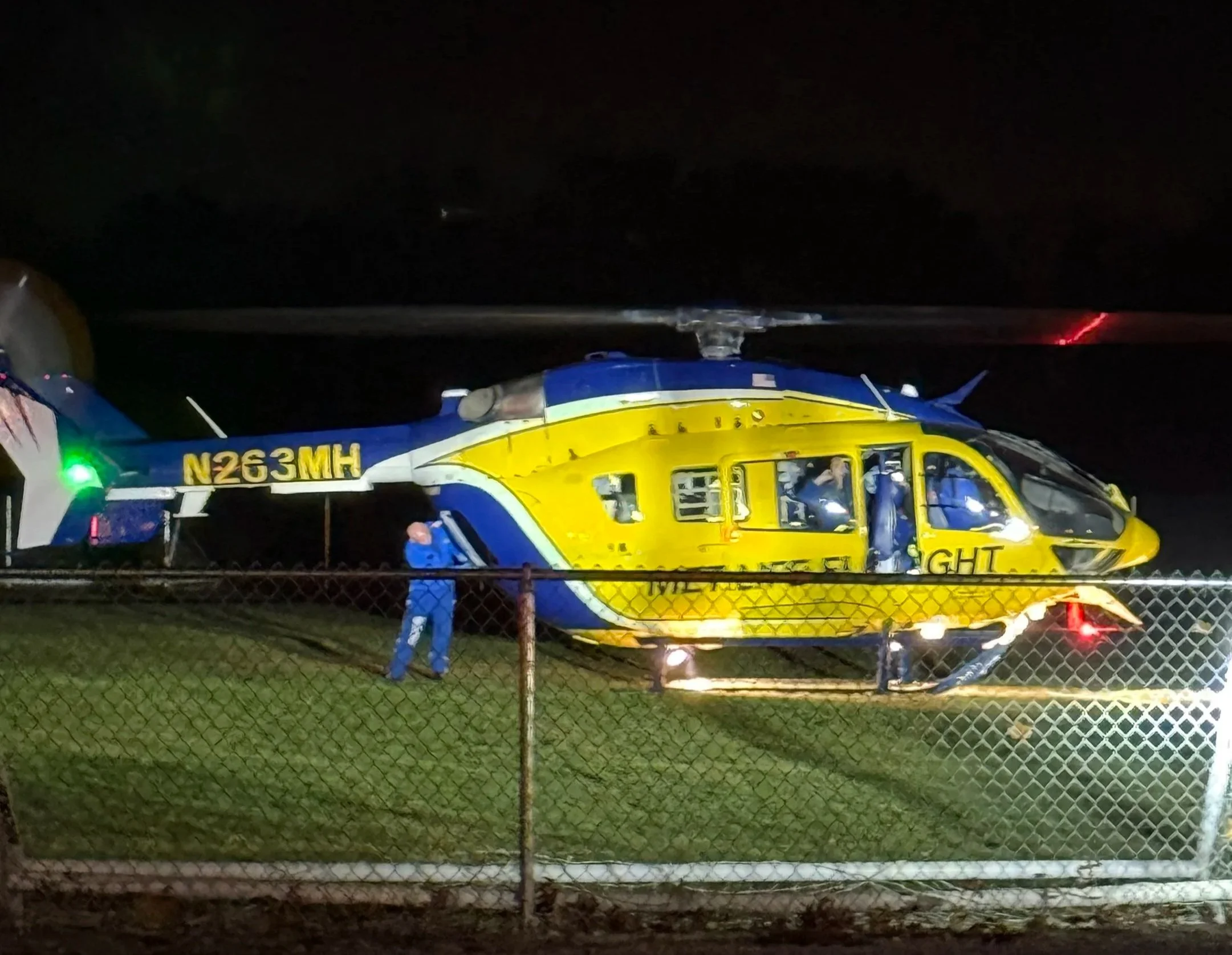
Brother Jacob ran over and lit up into the ambulance and shared a few moments with Enos before he was loaded into the waiting chopper.
The helicopter flight crew said they were taking Enos to Summa Akron City hospital.
The family asked us: “could you take us to Mt. Eaton to pick up our parents and take us to the hospital?”
Yes, we replied. Let’s go.
We looked at the clock and the time for our dinner reservations was drawing near. We texted our friends and let them know what was going on and that they should go ahead with dinner.
We picked up Eli and Rebecca in Mt. Eaton and headed for Akron.
One of the sisters had her sick bucket and would periodically remove the lid to wretch into it as we drove north. She’d put the lid back on it and set it on the armrest between my wife and I, where it gently slopped back and forth as we trundled along. It was a gallon bucket, half-full by the time we got to Akron.
I was glad she had the foresight to bring the bucket. And the lid.
After we dropped the family off, we looked at the time and thought … “hmmm, we should see if we can catch the back half of supper club”.
We drove in silence for a while, just trying to process what we had witnessed and participated in that evening.
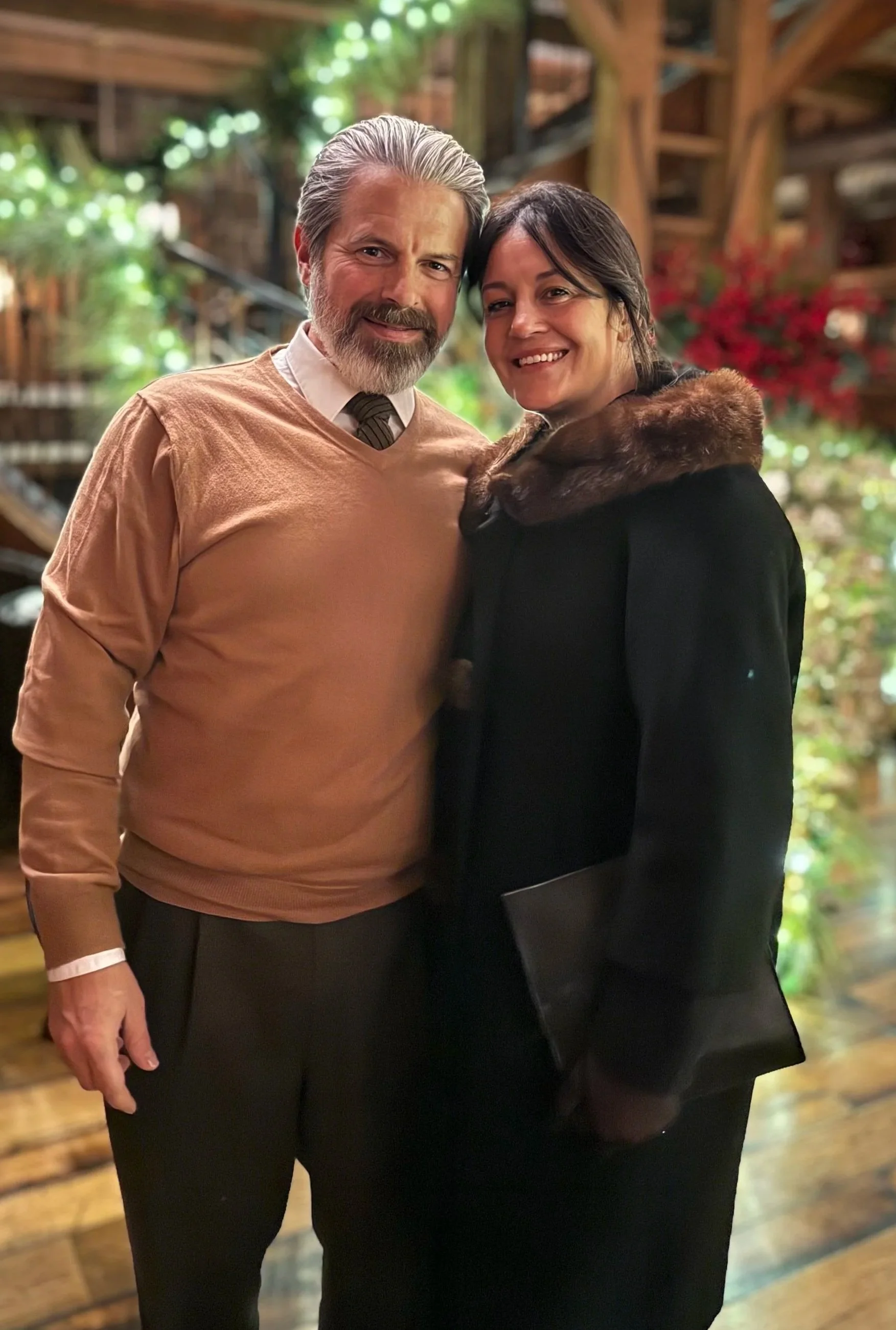
I held my wife’s lace-gloved hand in my hand as we quietly drove to the bistro. As we pulled into the vineyard, the beautiful Christmas decorations and lovely surroundings offered a profound environmental shift.
We paused outside the heavy doors of the restaurant and gazed into each other’s eyes.
“OK. Reset. Deep breath.”
We took a selfie to commemorate the occasion, then turned and strode into the fine dining restaurant to join our friends.
Such is our life in the “dash”, the hyphen between two worlds.
We ordered dinner, drank some wine and cocktails, and slowly unwound the tension that had built up throughout our unplanned adventure.
Just keep saying YES
Occasionally God brings me to a situation where I sense that he just wants me to keep saying “yes”. I ALWAYS learn something fascinating after the first few “YES” moments. It doesn’t start getting good until the “YES” starts to be a little uncomfortable.
That’s the way it felt when we encountered Enos lying face down on that cold stretch of pavement in Northeast Ohio.
Just keep saying yes.
My wife Mary June and I looked back on the experience and marveled that we both just kind of knew what the next right thing was. We didn’t circle up and make any decisions about driving to Akron or potentially missing supper club. We just moved in unison, flowing from “yes” to “yes” as we moved through that evening. Her lace gloved and bejeweled hand in mine as we drove with a half-gallon bucket of vomit between us.
Of course. Yes.
A week later we would go visit our new Swartzentruber Amish friends at the hospital. We didn’t know what we would find when we got there, but were happy to see Rebecca (Enos’s mother) in the waiting room when we arrived. It took her a few seconds to compute who we were, but a warm smile spread across her face as she recognized us.
We all went back in to see Enos, who was laying face up this time. I introduced myself, my wife and our baby girl and told him it was good to see his face this time, rather than the back of his head.
Remarkably, he remembers everything from the night of the accident. He had a keen sense of time passing - he thought it was about 25 minutes from the time he was struck to the time he was placed in the ambulance, which is correct. He remarked that it was very comforting to hear his mother tongue spoken to him as he lay helplessly face down on that cold stretch of road. His efforts to tell me where to find his family and communicate their whereabouts were a helpful distraction for him as he waited to be rescued.
He is paralyzed from the waist down, with limited use of his arms currently, but has bright eyes, and easy smile and a strong presence. He is a bright and strong young man. His beautiful girlfriend stood resolutely by his bedside, gently rubbing his shoulders and neck.
His sisters and parents gathered with us around his bed and we shared a few moments together before it was time to leave. I asked if I could pray for Enos before we leave. I confessed that I was more comfortable praying in English, so if it’s ok we would do it that way. They chuckled and nodded their assent as they bowed their heads. I lead us in prayer for Enos, praying for healing, for strength, and for comfort, and for God’s will to be accomplished in all of these things.
Enos raised his hand to mine and I held his hand and looked into his eyes. “Thank you” he said, from the bottom of his heart.
“You’re welcome, brother” I replied. “Get well soon.”
His mom Rebecca insisted on sending some homemade apple pie with us, which she efficiently cut and slid onto a paper plate in the hospital waiting room.
She paused to wipe some tears and clean her nose. She confessed that our prayer time had moved her to tears and assured us that the tears we saw were “tears of love”.
Eli and Rebecca thanked us profusely again for “being their friends in their hour of need”. We left with our hearts warmed by the deep sense of friendship and connection we felt with the Hershberger family.
The differences between us can either be a barrier between us or a fascinating set of features that highlight our humanity.
When we “enter in”, when we don’t look away, when we unflinchingly face the fullness and depth of the human condition , when we keep living into the “dash” and saying “yes”, even in the suffering—especially in the suffering, the differences become something beautiful and interesting.
Uniting us instead of dividing us.
Eli, Rebecca, Enos, and their family have lead a life so remarkably different than my own that you might think we have nothing at all in common.
For reference, the Swartzentruber Amish are so conservative that I would describe the differences between them and the Old Order Amish as being about equal to the degree of difference between the Old Order Amish and the ‘English’ world at large.
I came away from my encounter with the Hershbergers with the sense that these people know something that many of us have forgotten. They are remarkably committed to their path and they have absolutely no desire to convince us to it. Not once did I get the sense that they think they are right and we are wrong.
They are who they are, and we are who we are.
We can be friends and neighbors and good human beings, loving each other well without trying to change each other.
In a world gone mad, utterly drunk on the power of technological sophistication, it is a gift to have in our community a group of people who will not even use a battery operated calculator.
Of course it was not lost on any of us that Enos had flown in a helicopter and was currently the beneficiary of many life-saving technologies, even as he was laying in that hospital bed.
Even from his position on the very fringe of the modern world, Enos was “living in the dash” - the space between worlds where computers monitored his every heartbeat, yet he would return soon to a home without running water, lit by oil lanterns.
I share this story to encourage you to get comfortable in the hyphenated spaces that life brings you to.
Learn to “sit shiva”, mourn with those who mourn, and rejoice with those who rejoice.
Don’t try to change people.
Live a life that is a blessing to your family, to yourself, and to everyone you meet.
When you know God, you understand yourself. When you understand yourself, you can spend time in the “dashes” of human experience without losing yourself.
The wise man who can lead his family fearlessly into the future will be the one who knows God and knows himself to such a degree that it allows him to enter into a shared human experience with someone very different than him, without fearing that he will lose something essential about himself in the process.
I sense that we are in a very fast-changing world and we need men who are an absolute anchor of peace and clarity. Who have the courage to open their hearts, pour out their gifts, connect deeply, and remain utterly unshaken in the Love of the One who holds us all.
Do the work now to become that man.